

Housing Downturn Deepens
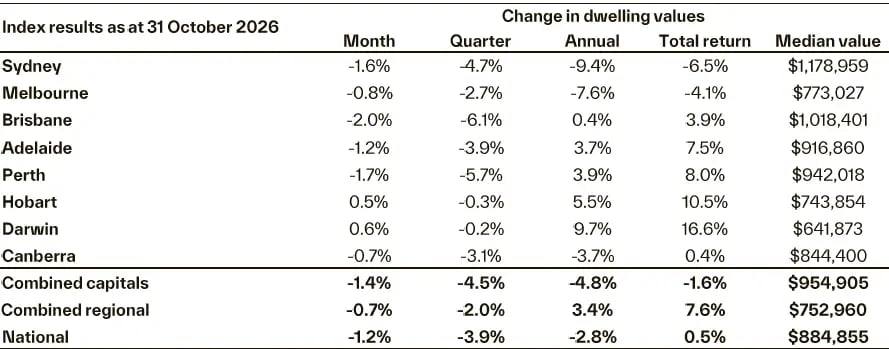
Australia’s housing market weakened further through October, with the national prices falling 1.2%, marking a seventh consecutive monthly decline. National dwelling values are now 6.7% below their March peak, equivalent to a reduction of approximately $63,400 in the median dwelling value. Annual growth has also moved into negative territory, with values down 2.8% over the past year.
Brisbane and Perth have overtaken Sydney as the weakest-performing capital cities in the past month, with dwelling values declining 2.0% and 1.7% respectively in October. Sydney values fell 1.6%, taking the annual decline to 9.4%, while Melbourne recorded a more moderate 0.8% monthly fall. The downturn is now particularly pronounced across the mid-sized capitals, with Brisbane, Perth and Adelaide recording quarterly declines of 6.1%, 5.7% and 3.9% respectively.
Source: Cotality Home Value Index, results as at 31 October 2026.
Properties Are Taking Longer to Sell
Selling conditions have softened further as buyer demand weakens. The national median selling period has increased to 41 days, compared with 24 days at the same time last year. Capital city properties are taking a median 39 days to sell, while regional properties are averaging 45 days, with both markets reaching their highest levels since 2020.
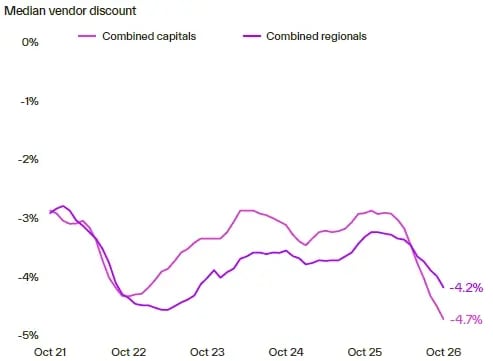
Price negotiations are also becoming more significant. Across the combined capital cities, the typical vendor discount has widened to 4.7%, while the regional market has reached 4.2%. Nationally, sellers are now accepting prices approximately 4.5% below their original asking price, the largest discount since mid-2019.
For purchasers, this represents a more favourable environment, with longer selling periods and greater willingness from vendors to negotiate providing additional opportunities to secure properties on better terms. The issue however for many purchasers, particularly first home buyers, is the rising interest rate environment which means loan repayments are higher and therefore it is more difficult to obtain and service a loan.
Even borrowers with good repayment history on existing loans are finding it difficult to refinance due to having to meet serviceability criteria on new loans, making policies like Rate Money’s Like for Like refinance more of a differentiator in the current lending climate.
Source: Cotality Monthly Housing Chart Pack, November 2026.
More Properties Are Accumulating on the Market
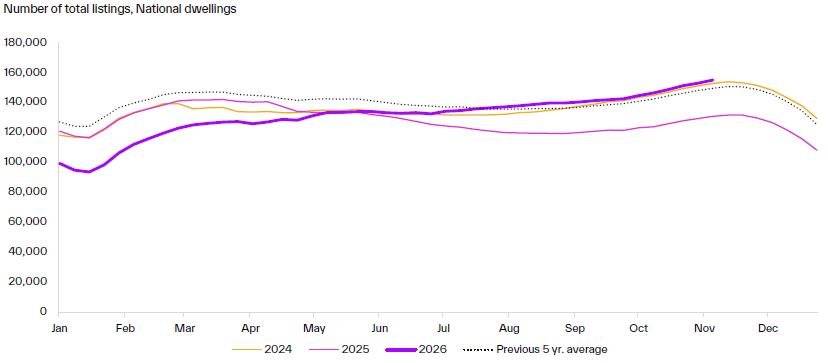
The number of properties advertised for sale continues to rise, despite the volume of new listings coming to market being lower than in previous years. Over the four weeks ending 8 November, there were 155,055 properties advertised nationally, 18.6% higher than 12 months ago.
During the same period, 38,207 new properties were listed for sale, 13.9% lower than a year earlier. This highlights that the increase in available stock is being driven largely by properties taking longer to sell, rather than a surge in new supply.
The trend is particularly evident in Brisbane, where total listings have increased 59.5% over the year despite new listings falling 12.4%. With fewer buyers competing for properties and more stock available, purchasers are gaining greater choice and negotiating power.
Source: Cotality Monthly Housing Chart Pack, November 2026.
Rental Market Continues to Ease
Rental market conditions are also beginning to loosen, with the national vacancy rate rising to 2.3% in October, its highest level since January 2022. While still below the pre-COVID decade average of 3.3%, vacancy rates are now higher than a year ago across every capital city except Darwin.
National rents increased 5.3% over the past year, down from 6.0% annual growth recorded between May and July. Regional markets continue to outperform the capitals, with annual rental growth of 5.5% compared with 5.2%.
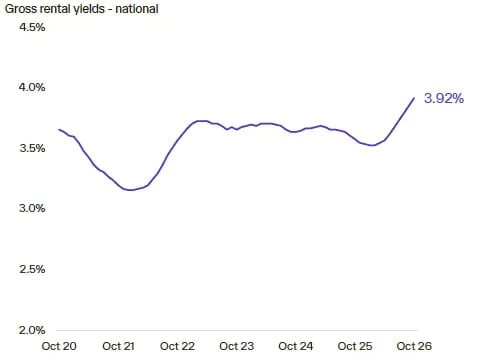
As rents continue to rise while property values decline, gross rental yields are increasing. The national gross rental yield reached 3.92% in October, its highest level in more than seven years, while the combined capital city yield reached 3.8%.
Source: Cotality Home Value Index, results as at 31 October 2026.
Overall, the housing market is experiencing a broad-based correction, with weaker demand, higher borrowing costs and increased selling periods putting downward pressure on values. However, limited new housing supply and ongoing population growth should provide some underlying support as the market moves through the current downturn.